Changing Chords
Clean chords are step one. Changing between them in time is step two—and it's where most beginners feel stuck. The fix is deliberate, slow practice with a clear target.
The Golden Rule
Slow and smooth beats fast and sloppy. Use a tempo where you can land the next chord before the downbeat. Speed comes later.
Two-Chord Drills
Alternate every two bars. Keep strumming even if the left hand is late—your rhythm hand is the boss.
Em ↔ G
X:1
T:Em and G — Two Bars Each
K:G
M:4/4
L:1/4
"Em" [EGB] [EGB] [EGB] [EGB] | [EGB] [EGB] [EGB] [EGB] | "G" [GBd] [GBd] [GBd] [GBd] | [GBd] [GBd] [GBd] [GBd] ||
G ↔ C
X:2
T:G and C — Two Bars Each
K:G
M:4/4
L:1/4
"G" [GBd] [GBd] [GBd] [GBd] | [GBd] [GBd] [GBd] [GBd] | "C" [CEG] [CEG] [CEG] [CEG] | [CEG] [CEG] [CEG] [CEG] ||
Am ↔ E (or Em)
X:3
T:Am and Em — Two Bars Each
K:Am
M:4/4
L:1/4
"Am" [Ace] [Ace] [Ace] [Ace] | [Ace] [Ace] [Ace] [Ace] | "Em" [EGB] [EGB] [EGB] [EGB] | [EGB] [EGB] [EGB] [EGB] ||
Turn on Chords and watch shapes change measure to measure. Memorize the feel, not just the picture.
One Beat Earlier
Lift fingers on the last upstroke of the old chord. Land the new shape on the downbeat. Practice without strumming: Em → G → Em → G, one change every four beats, then every two, then every bar.
Four-Chord Loop
This progression appears everywhere—master it and you'll recognize it in dozens of songs:
X:4
T:G — D — Em — C
K:G
M:4/4
L:1/4
"G" [GBd] [GBd] [GBd] [GBd] | "D" [D^FA] [D^FA] [D^FA] [D^FA] | "Em" [EGB] [EGB] [EGB] [EGB] | "C" [CEG] [CEG] [CEG] [CEG] ||
One bar per chord. Loop for five minutes. Use Practice Goals to track "clean G-D-Em-C changes at 60 BPM."
Pivot Fingers
When two chords share a finger position, leave that finger down and move the others. Em and G share fingers on some voicings; Am and C often share the 1st fret on the B string. Look for anchors in the Chords view.
Common Mistakes
- Stopping the strum hand to place fingers — keep the rhythm going
- Looking at the fretboard only — glance, then trust muscle memory
- Gripping too hard — relax between changes

Practice tip: Set a timer for 3 minutes. Count how many clean cycles of G–D–Em–C you complete. Repeat tomorrow and try to beat your score by one—not by rushing, by smoothing the motion.
Further viewing
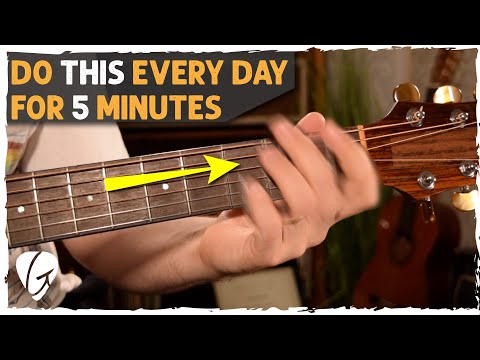
- —slow accuracy work plus speed rounds in one focused routine
- (Lauren Bateman)—finger preparation, dexterity, and daily practice structure

Next: put chords, strumming, and changes together in your first song progressions.
©Music Buddy