Reading Tab
Tab (tablature) shows where to put your fingers on the fretboard. It doesn't replace standard notation, but it's the fastest way for guitarists to learn new music—and every example in Music Buddy can show tab alongside the staff.
How Tab Works
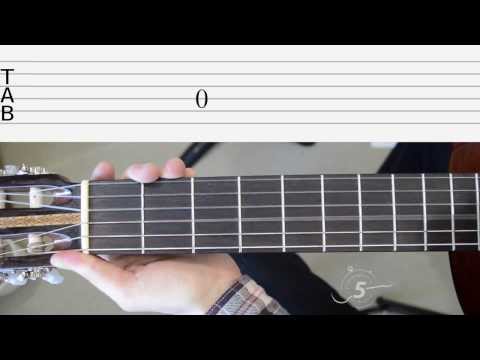
Six horizontal lines = six strings:
- Bottom line = low E (thickest string)
- Top line = high e (thinnest string)
Numbers on a line = which fret to press on that string.
0 = open string (no finger down).
Example: 3 on the bottom line = 3rd fret, low E string.
Reading a Simple Melody
This fragment of Mary Had a Little Lamb uses only the top three strings—perfect for beginners:
X:1
T:Mary Had a Little Lamb (Fragment)
K:D
M:4/4
L:1/4
B A G A | B B B2 | A A A2 | B d d2 ||
In Music Buddy, turn on Tab to see the fret numbers under each note. Play slowly: one note at a time, one finger at a time.
Open String Melody — Ode to Joy
Beethoven's famous theme fits nicely on open strings and the 2nd fret:
X:2
T:Ode to Joy (Fragment)
K:D
M:4/4
L:1/4
D E F# G | G F# E D | C D E C | A,4 ||
Use Tab to locate F# and C on the neck. Match the rhythm in the app before speeding up.
Chords in Tab
When you see stacked numbers (or chord names above the staff), strum all indicated strings together. Music Buddy's Chords toggle draws the familiar diagram shapes—useful once you start learning open chords.
X:3
T:Open E String Rhythm
K:E
M:4/4
L:1/4
E, E, E, E | E,2 E,2 ||
Four steady plucks on the low E—tab would show 0 on the bottom line four times.
Tab vs Standard Notation
| Tab | Standard notation |
|---|---|
| Shows fret and string | Shows pitch and rhythm |
| Guitar-specific | Works for any instrument |
| Easy to start | Better for complex rhythms |
Music Buddy shows both. Learn tab first for speed; let the staff teach rhythm and pitch over time.
(Fender)—string lines, fret numbers, open strings, and reading left to right.
Practice tip: Pick one example, hide the tab, try from the staff, then reveal Tab to check yourself. Alternate both ways to build fluency.
Further viewing
- —a concise walkthrough using simple melodies and chord stacks
- —hammer-ons, pull-offs, bends, and other tab markings you'll meet later

Next: the basics of standard notation—staff, notes, and rhythm—so the staff becomes a friend, not a mystery.
©Music Buddy