Introduction to Lead Guitar
Rhythm guitar holds the song together; lead guitar carries the melody, fills, and solos. You do not need dozens of scales to start—one pentatonic box and a simple chord progression are enough to play your first musical lines.
This lesson is a preview. The Lead Guitar Fundamentals series goes deep on pentatonics, modes, arpeggios, and harmony. Think of this chapter as the on-ramp.
A Minor Pentatonic Box
The A minor pentatonic scale uses five notes and fits naturally over Am, C, F, and G progressions in the key of A minor / C major.
X:1
T:A-Minor Pentatonic Scale
K:Am
L:1/4
"Am"A c d e g a ||
A (root), C (minor 3rd), D (4th), E (5th), G (minor 7th). Root A lives at the 5th fret of the low E string—that is your anchor.
Play the scale in Music Buddy with Tab on to see the box shape. Turn on Chords to overlay an Am grip and see how scale tones relate to the chord.
—root notes, movable minor pentatonic shapes, and why the box works over Am-G-F style progressions.
The Chord Progression
A classic Am–G–F loop—slow ballad or rock backing, same scale works throughout:
X:2
T:Am-G-F Progression
K:Am
M:4/4
L:1/2
"Am"[ACE]2 "G"[GBd]2 | "F"[FAc]2 "F"[FAc]2 ||
Loop this progression and hum a melody before you pick up the guitar. Your ear often finds better lines than your fingers guess at.
A Simple Lick
Four bars over Am–G–F—all pentatonic tones, landing on A at the end:
X:3
T:Simple Lick Over Am-G-F
K:Am
M:4/4
L:1/8
"Am"A, c d e g e | "G"d c A, G, A, | "F"e d c A, G, | "Am"A,4 z4 ||
Play it slowly. Notice how A, C, and E—the notes of Am—feel like home over the first bar. Over G, G and D (the 5th of G) sound strong. Over F, aim for F, A, or C.
—targeting chord tones and adjacent pentatonic ideas so phrases respond to the progression.
Scale Pattern Practice
Build finger memory with an up-and-down pattern before improvising:
X:4
T:A-Minor Pentatonic Pattern
K:Am
M:4/4
L:1/8
A,2 c2 a2 c2 | d2 e2 d2 e2 | g2 a2 g2 a2 | e2 d2 c2 A,2 ||
Once the notes are comfortable, leave out notes, repeat motifs, and leave space—silence is part of lead guitar.
Playing Over Chords
Three rules to start:
- Land on chord tones at strong beats—root, 3rd, or 5th of the current chord
- Use pentatonic notes between chord tones as passing tones
- Leave space—four good notes beat sixteen random ones
X:5
T:Targeting Chord Tones
K:Am
M:4/4
L:1/8
"Am"A,2 c2 e2 | "G"G,2 B,2 d2 | "F"F,2 A,2 c2 | "Am"A,4 z4 ||
Each measure outlines the underlying triad—exactly what the Lead Guitar Fundamentals series expands on with pentatonics, modes, and arpeggios.
Practice tip: Loop the Am–G–F backing and play only three notes per bar. Constraint forces you to be melodic instead of mechanical.
Further viewing
- (JustinGuitar)—using scale notes as musical phrases instead of exercises
- —roots, octaves, five-note structure, and movable scale logic
- —linking boxes so lead lines move beyond one position

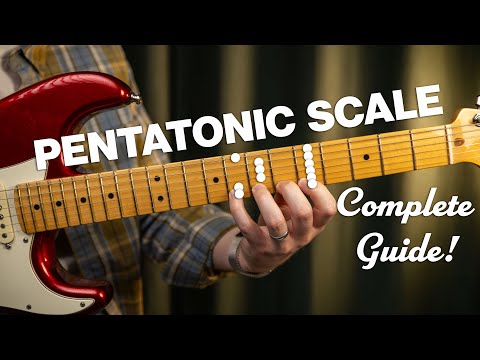

Ready for more? Continue with Lead Guitar Fundamentals—pentatonics, major scale harmony, modes, and arpeggios await.
©Music Buddy