Knowing the Fretboard
Moveable chords and scales only click when you know where you are on the neck. This lesson builds a map using the natural notes on the two thickest strings and a simple octave pattern you can use anywhere.
Open String Names
From lowest to highest, standard tuning is E–A–D–G–B–E. You already know those from tuning. Everything else is counted from there.
Natural Notes on the Low E String
Natural notes follow the alphabet with two exceptions: no sharp or flat between B and C, or E and F.
X:1
T:Natural Notes on Low E String
K:C
L:1/4
E, F, G, A, B, C D E ||
Use the staff to read the letter names, then play every note on the 6th string—E, F, G, A, B, C, D, E from open to the 12th fret.
Landmark frets on the low E string: F at fret 1, G at fret 3, A at fret 5, C at fret 8, D at fret 10, and E again at fret 12.
—natural notes on single strings, the B-C and E-F exceptions, and octave shortcuts for mapping the neck.
Natural Notes on the A String
Same alphabet walk, starting on A:
X:2
T:Natural Notes on A String
K:C
L:1/4
A, B, C D E F G A ||
Play on the 5th string only, using the same idea as the low-E drill. Tab will again spread pitches across strings—follow the landmarks instead.
Key landmarks: C at fret 3, D at fret 5, E at fret 7, G at fret 10, and A again at fret 12.
Finding Octaves
An octave is the same note name, higher or lower. On guitar, one reliable pattern: from any note on the 6th string, move to the 4th string (D string) two frets higher—or stay on the 6th string and go up 12 frets.
From E on the open low E string, the octave E lives at the 12th fret:
X:3
T:Octave on Low E String
K:C
L:1/4
E, z z z z z z z E ||
The two-fret skip pattern: note on the 6th string → same note on the 4th string, two frets higher:
X:4
T:Octave Pattern (6th to 4th String)
K:G
L:1/4
G, z z G ||
Here G on the 3rd fret of the low E string pairs with G on the 5th fret of the D string.
From the 5th string, octaves often jump to the 3rd string two frets higher—same idea, different string pair:
X:5
T:Octave Pattern (5th to 3rd String)
K:C
L:1/4
C z z c ||
C at fret 3 on the A string matches C at fret 5 on the G string.
(Justin Sandercoe)—moveable patterns for finding any note.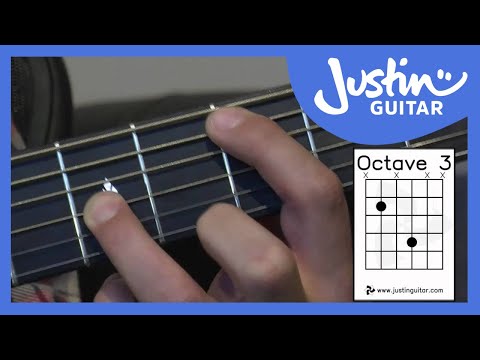
Putting It Together
Find these notes without looking at a chart—use the low E and A strings as anchors:
X:6
T:Find the Notes Quiz
K:C
M:4/4
L:1/2
"C"C "G"G, | "F"F, "A"A, ||
Play C (8th fret low E or 3rd fret A), G (3rd fret low E), F (1st fret low E or 8th fret A), A (5th fret low E or open A). Use octaves to double-check you landed on the right pitch.
Practice tip: Pick one song you know and name the root note of each chord as you play it. "That's G... C... D..."—connects chord shapes to the map on the neck.
Further viewing
- —octave scaffolding for finding any note
- (JustinGuitar)—practical memorization

Next up: essential techniques—hammer-ons, pull-offs, slides, and bends.
©Music Buddy