Power Chords
Power chords are two-note shapes—root and fifth—that sound huge through a distorted amp. They are neither major nor minor, which makes them easy to move anywhere on the neck. If you have heard classic rock, punk, or metal rhythm guitar, you have heard power chords.
Root and Fifth
A power chord strips harmony down to root and 5th. Add the octave of the root on top and you get the familiar three-finger grip—but only two different pitch classes matter.
X:1
T:E Power Chord
K:E
L:1/4
"E5"[E,B,E]4 ||
X:2
T:A Power Chord
K:A
L:1/4
"A5"[A,EA]4 ||
X:3
T:G Power Chord
K:G
L:1/4
"G5"[G,DG]4 ||
Play each shape in Music Buddy with Tab on to see standard fingerings—usually root on the 6th or 5th string, fifth two frets higher on the next string, octave two frets higher again on the same string as the fifth.
(Marty Music)—two- and three-note grips, muting, and moving roots around the neck.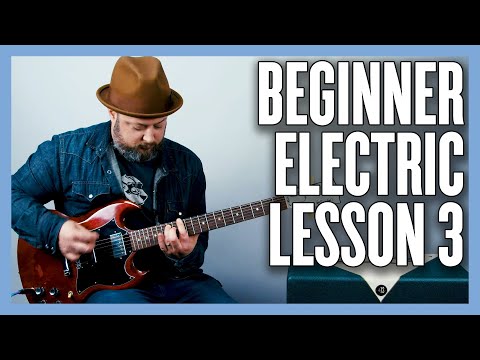
Moveable Shapes
Slide the same grip up the neck. Fifth fret on the low E string is A5, seventh fret is B5:
X:4
T:Moveable Power Chords
K:C
M:4/4
L:1/2
"A5"[A,EA]2 "B5"[B,^FB]2 | "C5"[CGc]2 "D5"[DAd]2 ||
The note you fret on the lowest sounding string names the chord. For this moveable example, turn on Tab and choose a higher fretboard position (try Pos 6) so the tab shows the low-E-root shape instead of open-position alternatives.
Palm Muting and Rhythm
Power chords come alive with palm muting—rest the side of your picking hand lightly on the strings near the bridge for a tight, chunky sound. Unmute on accented beats for contrast.
X:5
T:Power Chord Rhythm (Palm Muted)
K:E
M:4/4
L:1/8
"E5" E,2 E,2 E,2 E,2 | E,2 E,2 E,4 | "A5" A,2 A,2 A,2 A,2 | A,2 A,2 A,4 ||
Strum eighth notes steadily. Keep the motion going even when strings are muted—the rhythm lives in your right hand.
(Justin Sandercoe)—moving root shapes and finding the bridge-hand sweet spot for tight rock rhythm.
A Classic Progression
I–IV–V in power chords—think countless rock anthems:
X:6
T:I-IV-V Power Chord Progression
K:E
M:4/4
L:1/2
"E5"[E,B,E]2 "A5"[A,EA]2 | "B5"[B,FB]2 "E5"[E,B,E]2 ||
Use downstrokes only at first. Add palm muting on beats 2 and 4, open up on 1 and 3, and you already sound like a rhythm player.
Practice tip: Practice the right-hand mute without fretting anything—just chunk-chunk-chunk on open strings until the motion is automatic. Then add the left-hand shapes.
Further viewing
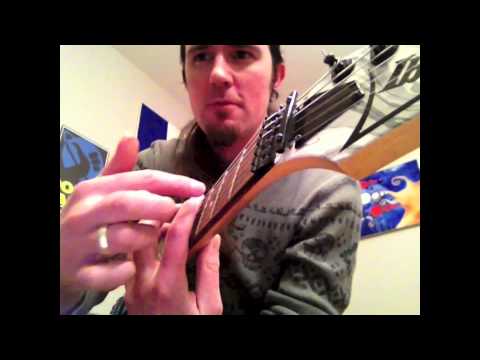
- (Ben Eller)—left-hand muting for cleaner distorted rhythm
Next: knowing the fretboard—note names and octave patterns that make everything moveable.
©Music Buddy