
The Secret - Linking Scales to Harmony
Your solo is always heard against the chords the band is playing. The notes you choose either fit those chords or fight them.
Rule #1: Notes in the current chord almost always sound good in your solo.
That matters most when you land on a note—at the end of a phrase or the end of your solo. Those landing notes are often chord tones: the notes that make up the chord, played one at a time (an arpeggio).
Here are the chord tones of C major, followed by the full C major scale:
X:1
T:C-Major Chord (Arpeggio)
K:C
L:1/4
"C"C E G c ||
X:2
T:C-Major Scale
K:C
L:1/4
"C"C D E F G A B c ||
Each example is playable in Music Buddy. If you are not sure where a note sits on the guitar, turn on the Tab toggle in the player to show tablature under the staff—you can also pick a fretboard region if you want a different position. For the arpeggio examples, turn on the Chords toggle to display chord diagrams alongside the music.
Play both slowly. Notice that C, E, and G appear in both examples—they are the chord tones. The other scale notes add color, but the chord tones are the safest places to land.
Here is a simple phrase over C major. Each measure ends on a chord tone—C, E, G, then C again an octave higher:
X:3
T:Land on Chord Tones
K:C
M:4/4
L:1/4
G E D C | G F D E | E D G2 | G E D c ||
For a guitar-focused demo of landing on chord tones, see
(Creative Guitar Studio).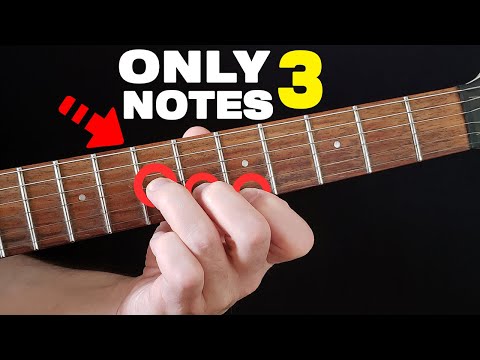
Why the Pentatonic Scale Works
The major scale uses seven notes. Two of them—F and B—sit a half-step (one fret) away from chord tones in C major. Played carelessly, they can sound tense against a C chord.
The pentatonic scale removes those two notes. Same scale, fewer wrong notes:
X:4
T:C-Major Pentatonic (F and B removed)
K:C
L:1/4
"C"C D E G A c ||
Five notes, hence penta. That is the main reason guitarists reach for pentatonic scales so often—they are hard to mess up over most chord progressions. The next lesson goes deeper into pentatonic major and minor.
—and why the pentatonic shape is so central to guitar soloing.
Same notes, different starting point: The C major pentatonic uses the same notes as A minor pentatonic—just starting on A instead of C:
X:5
T:A-Minor Pentatonic (same notes as C-Major Pentatonic)
K:Am
L:1/4
A c d e g a ||
Play both pentatonic examples. Same pitches—different mood depending on which note you treat as home.
See
(Dustin Hofsess) for a quick fretboard demo of this idea.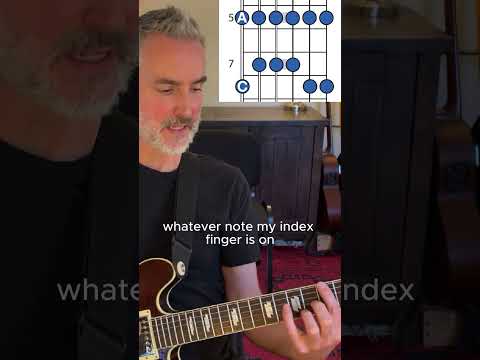
Practice tip: When learning any scale, find the root (C here) and the third (E). Those two notes tell you whether the sound is major or minor.
Further viewing
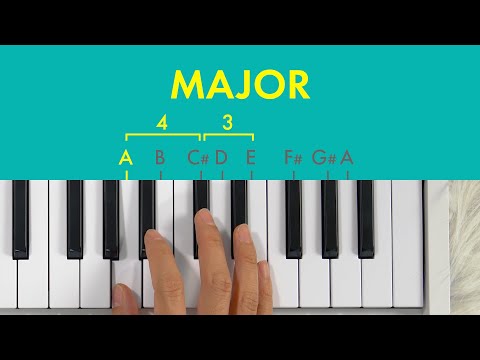
- (Andrew Huang)—chords, harmony, and how melodies relate to them
- —practical arpeggio shapes over a chord progression
Practice these examples before moving on.
©Music Buddy