
Major Scale Functional Harmony
Stack every other note of the C major scale in thirds and you get the chords that define Western pop and rock harmony. Each chord has a function—a tendency to pull toward or away from home (C):
- C (I) — tonic, home
- Dm (ii) — pre-dominant color
- Em (iii) — passing color
- F (IV) — subdominant, lifts away from home
- G (V) — dominant, strongest pull back to I
- Am (vi) — relative minor
- Bdim (vii°) — leading-tone tension
Here is the diatonic sequence as arpeggios—one chord per bar:
X:1
T:Diatonic Triads from C Major
K:C
M:4/4
L:1/4
"C" C E G c | "Dm" D F A d | "Em" E G B e | "F" F A c f | "G" G B d g | "Am" A c e a | "Bdim" B d f b | "C" c e g c' ||
Each example is playable in Music Buddy. Turn on Chords to see each triad shape. Use Tab if you want to transfer these arpeggios to the fretboard.
Three Triad Types
A major triad is a major third plus a minor third (C–E–G). A minor triad reverses that order (D–F–A). Diminished stacks two minor thirds (B–D–F)—the most tense of the three:
X:2
T:Major Triad (C)
K:C
L:1/4
"C" C E G c ||
X:3
T:Minor Triad (Dm)
K:Dm
L:1/4
"Dm" D F A d ||
X:4
T:Diminished Triad (Bdim)
K:Bdim
L:1/4
"Bdim" B d f b ||
Why Ex. 2 in the Last Lesson Clashed
The G chord in C major is the V—it does not mean the song modulated to G major. Soloing in G major over that chord fights the key of C. Stay in C major (or C major pentatonic) and emphasize chord tones G, B, and D over the V chord instead.
The V → I cadence shows the pull home most clearly:
X:5
T:V-I Cadence (G to C)
K:C
M:4/4
L:1/4
"G" G B d g | "C" C E G c ||
Over G, tension is welcome—B wants to resolve up to C. When C arrives, land on C, E, or G for a clear release.
(Music Theory for Guitar) walks through this stacking idea on the fretboard.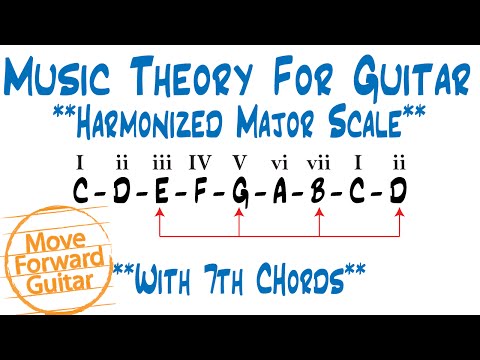
Practice tip: Over a V chord, lean into tension; over I, land on chord tones. That one habit makes functional harmony audible in your solos.
Further viewing
- (David Bennett)—why V wants to go to I
- (Andrew Huang)—chords built from scales

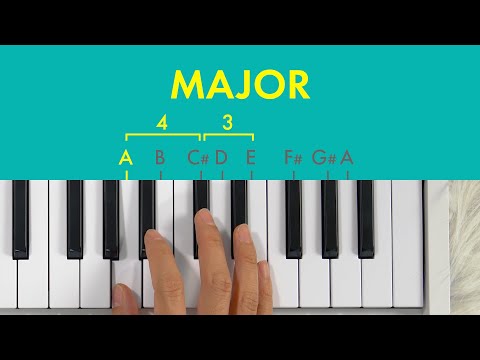
Next: modes of the major scale—same notes, different homes.
©Music Buddy