
The Simplified Approach
The easy way to use the major scale: match the key of the song. If the tune is in C major, play the C major scale throughout. Same idea for G, D, A, or any other key.
This works well when:
- The song stays mostly in one key
- Chords come from that key's harmony (no surprise borrowed chords)
- The tune feels major, not minor
It breaks down when chords step outside the key—you will hear notes fight the harmony. The exercise lesson that follows lets you hear that. The functional-harmony lesson explains why.
Finding the Key
Sheet music shows the key in the key signature. On guitar, you often infer key from the chords—especially the first and last chords of the song. If a tune in G ends on Em, it may be in E minor (relative minor of G), not G major.

Circle of Fifths shortcuts (when reading notation):
- Sharp keys: the key is one half-step above the last sharp.
- Flat keys: with two or more flats, the key is named by the second-to-last flat (memorize F major for one flat).
Common keys by style:
- Pop / country: G, C, D, A
- Rock (guitar): E
- Jazz: F, Bb, Eb
Scales in Common Keys
X:1
T:G-Major Scale
K:G
L:1/4
"G"G A B c d e ^f g ||
X:2
T:D-Major Scale
K:D
L:1/4
"D"D E ^F G A B ^c d ||
X:3
T:A-Major Scale
K:A
L:1/4
"A"A B ^c d e ^f ^g a ||
X:4
T:E-Major Scale
K:E
L:1/4
"E"E ^F ^G A B ^c ^d e ||
Each example is playable in Music Buddy. Use the Tab toggle to move these shapes on the fretboard. Turn on Chords to see the tonic chord for each key.
The W-W-H-W-W-W-H pattern never changes—only the root and the sharps or flats.
(Michael New) ties keys, signatures, and chord families together.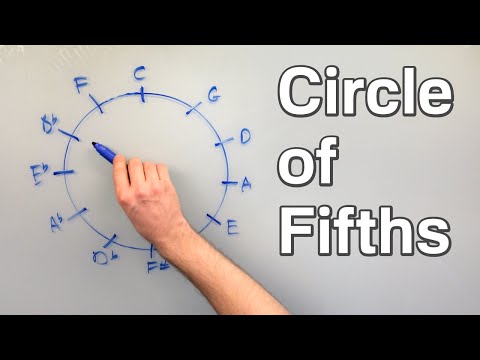
Practice tip: When you learn a new song, name the key first, then run that major scale once before you solo—even if you later use pentatonic or chord tones.
Further viewing
- (Brad Harrison Music)—quick visual map of keys
- (Rick Beato)—ears and chords, not just notation


Next: hear the simplified approach over a real chord progression.
©Music Buddy