Seventh Chords and Functional Harmony
Seventh chords add a fourth note—the 7th—that defines function more precisely than triads alone. In jazz and sophisticated pop, guide tones (3rd and 7th) drive your melodic choices.
Building Seventh Chords
Stack one more third above each triad:
X:1
T:Four Seventh Chord Types
K:C
M:4/4
L:1/2
"Cmaj7" [CEGB] | "Dm7" [F,A,d] | "G7" [G,B,d] | "Bm7b5" [B,F,A,d] ||
- maj7 — 1-3-5-7 (jazz tonic)
- m7 — 1-b3-5-b7 (subdominant color)
- 7 (dominant) — 1-3-5-b7 (tension, wants to resolve)
- m7b5 — 1-b3-b5-b7 (half-diminished, ii in minor keys)
Each example is playable in Music Buddy. Turn on Chords to see seventh-chord diagrams; use Tab for arpeggio fingerings.
Diatonic Sevenths in C Major
X:2
T:Seventh Chords in C Major
K:C
M:4/4
L:1/2
"Cmaj7" [CEGB] | "Dm7" [F,A,d] | "Em7" [G,B,e] | "Fmaj7" [FAce] | "G7" [G,B,d] | "Am7" [A,CEG] | "Bm7b5" [B,F,A,d] ||
Pattern: maj7, m7, m7, maj7, 7, m7, m7b5.
ii-V-I with Sevenths
The backbone of jazz improvisation:
X:3
T:ii-V-I with Seventh Chords
K:C
M:4/4
L:1/2
"Dm7" [F,A,d] | "G7" [G,B,d] | "Cmaj7" [CEGB]2 ||
- Dm7 — sets up motion (subdominant)
- G7 — creates tension (dominant)
- Cmaj7 — resolution (tonic)
Guide Tone Motion
The 3rd and 7th of each chord define its quality and voice-lead into the next:
X:4
T:Guide Tones Through ii-V-I
K:C
M:4/4
L:1/2
"Dm7" F2 | "G7" f2 | "Cmaj7" E2 ||
F (3rd of Dm7) stays as F (7th of G7), then drops to E (3rd of Cmaj7). Target these tones for smooth, connected lines.
Seventh Chord Arpeggios
X:5
T:Seventh Chord Arpeggios
K:C
M:4/4
L:1/8
"Cmaj7" C E G B c | "Dm7" D F A c d | "G7" G B d f g | "Am7" A c e g a ||
A Melodic ii-V-I Line
X:6
T:Line Over ii-V-I
K:C
M:4/4
L:1/8
"Dm7" D F A c | d c A F | "G7" D G B f | e d B G | "Cmaj7" G E C E | G B c2 ||
Chord tones on strong beats, guide-tone motion (F→F→E), smooth voice leading throughout.
Functional Families
Chords group by role:
- Tonic (I, iii, vi) — stable, at rest
- Subdominant (ii, IV) — motion away from home
- Dominant (V, vii°) — tension pulling to tonic
Recognizing function tells you when to build tension and when to resolve.
—voice leading, tension, and why dominant 7ths pull to tonic.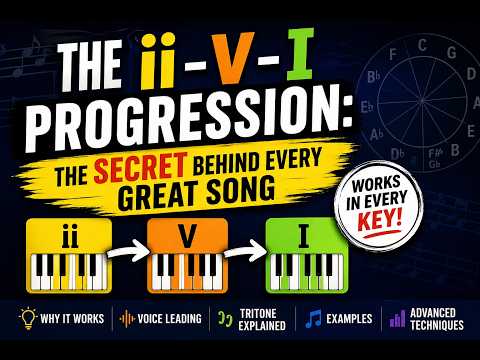
Practice tip: Play the guide-tone line (example 4) on one string. Hearing the 3rds and 7ths move is more valuable than memorizing arpeggio shapes across the whole neck.
Further viewing
- —dominant function beyond the diatonic V chord
Next: blending scales and arpeggios into one flowing approach.
©Music Buddy